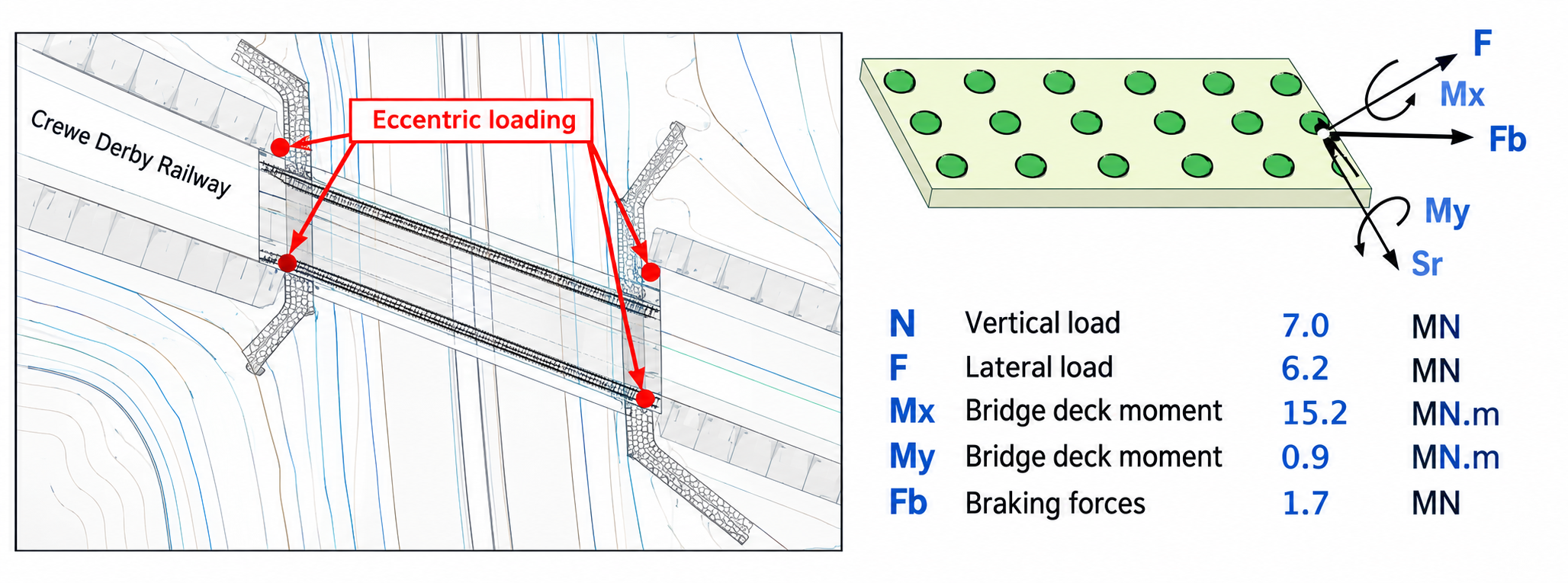
Pile group design for highway viaduct in central England, UK
NY Water Park
Repute has been used by Mott MacDonald (UK) for the design of a group of 18 piles with an initial length of 23m and a diameter of 900mm, subjected to a combination of vertical loads, horizontal loads and moments.
Reinstate West Project
Based on the original GI (mainly SPT-N values), preliminary pile group design has been carried out using Repute non-linear analysis. Subsequently, an additional GI (CPT, SCPT, piezocone, bender element test) and preliminary pile tests were carried out to confirm preliminary design (Fig. 10).
Reinstate West Project
Repute analysis for single pile was calibrated against the pile test data, using the Go profile derived from the additional GI.
Sky Tail Tower
This calibrated single-pile model was then incorporated into Repute to assess the pile group response, indicating that the pile groups were much stiffer than originally assumed (Fig. 13).
Sky Tail Tower
This has led to re-design of the pile groups with the front 2 rows of piles kept at 23m long, but the remaining rows of piles shortened to 15m. Pile reinforcement was also able to be reduced. This enabled a significant saving in pile lengths (about 25%) and construction schedule. It is essential to note that 7 out of 18 piles in the group were mobilizing most of their axial geotechnical capacity, however the remaining 11 piles had a “reserve” capacity so that it was possible to demonstrate that the “overall” foundation system was robust and had a more than adequate geotechnical capacity. This is a good example of “modern” pile-group design, based on the load redistribution operated by the rigid cap, as e.g. supported by the latest EN 1997-3: 2025, “Clause 6.5.5(11). The verification of geotechnical ultimate and serviceability limit states for single piles may be omitted provided it is verified that the pile cap is able to redistribute loads without itself exceeding an ultimate or serviceability limit state”.
O’Brien, A.S., Markvukaj, S. & Willoner, A. (2024). Pile-group design. In ICE Manual of Geotechnical Engineering, Second Edition, Volume II: Geotechnical Design, Construction and Verification (ed. M. Brown et al.), Emerald Publishing, ICE, London, Chapter 55, pp. 863-895.