
Pile foundation design
Numerical analysis and design of pile foundations
With this in mind, Geomarc offers a specialist consulting service on numerical modelling and design of pile foundations to contractors, engineers and developers. Our expert, Dr Francesco Basile, has over 25 years’ experience in numerical analysis and is the author of Repute‘s boundary element calculation engine, the UK’s leading pile design software used in thousands of major projects worldwide, from the Dubai Burj Khalifa to the London Wembley Stadium.

Our services
- You have limited in-house expertise/resources to dedicate to numerical modelling (e.g. pile groups, piled rafts, etc);
- You need someone to review your numerical analyses to increase your confidence;
- You need a design check, a peer review or an alternative solution to your pile design (e.g. to improve constructability or decrease construction costs);
- You need to tackle specific problems, such as the pile response due to earthquakes or to ground movements induced by tunnelling, landslides, excavations, consolidation, construction of adjacent piles or buildings, etc;
- You need to calibrate your preliminary pile analyses/design with the pile testing results in order to develop a truly serviceability limit approach for the final pile design.
Whether a small design check or a major R&D project, you will enjoy a high quality and cost-effective service tailored to fit your specific needs.
Pile group response
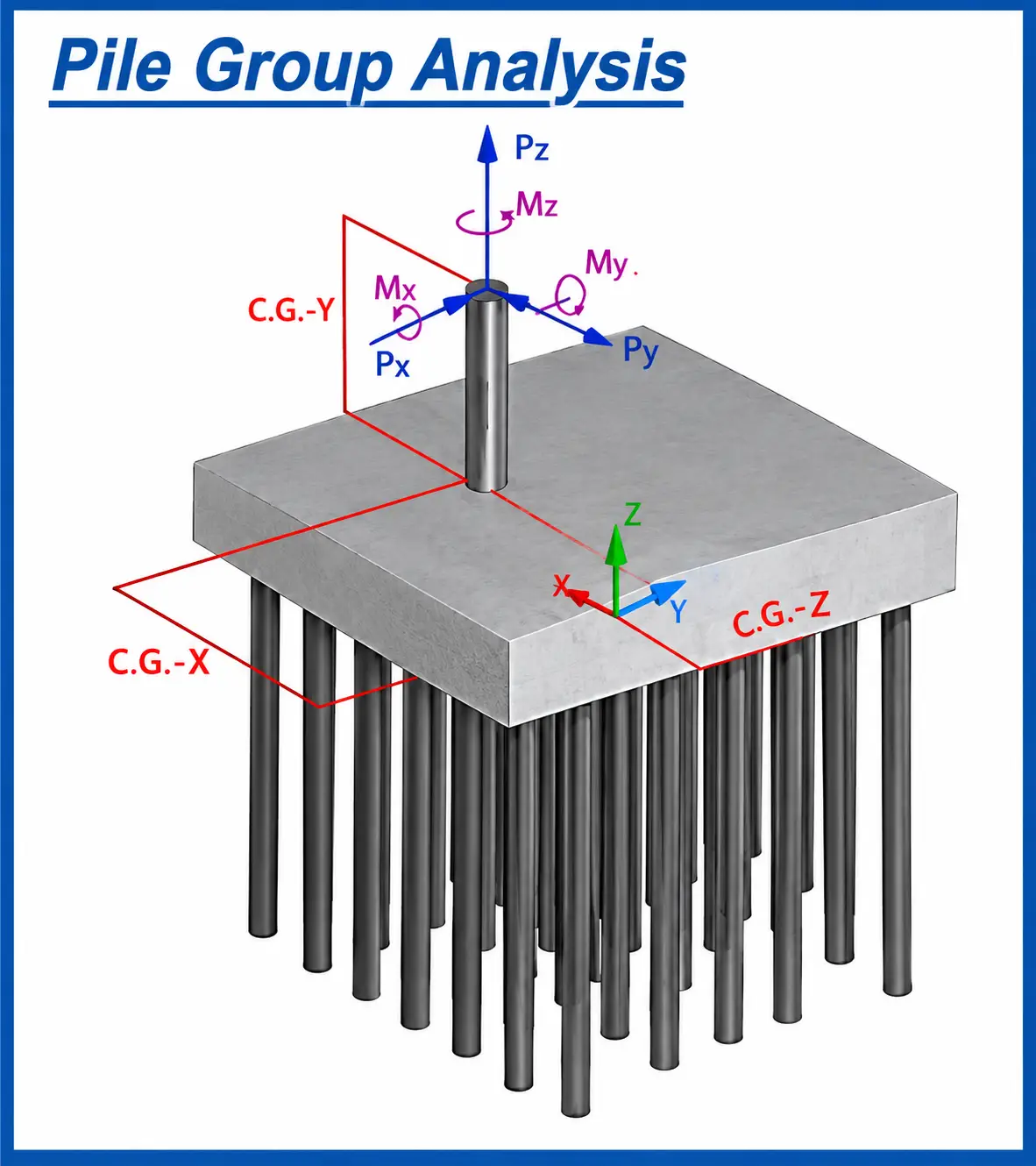
We offer a quick and efficient service for the numerical analysis of pile groups using Repute software (or any software of your choice). The key advantage of Repute lies in its capability to account for the continuous nature of pile-soil interaction while retaining a computationally efficient code. Other key features, such as soil nonlinearity effects, multilayered soil profiles and 3D effects, make Repute the most powerful tool to design pile groups in a rigorous yet cost-effective fashion.

Piled raft response
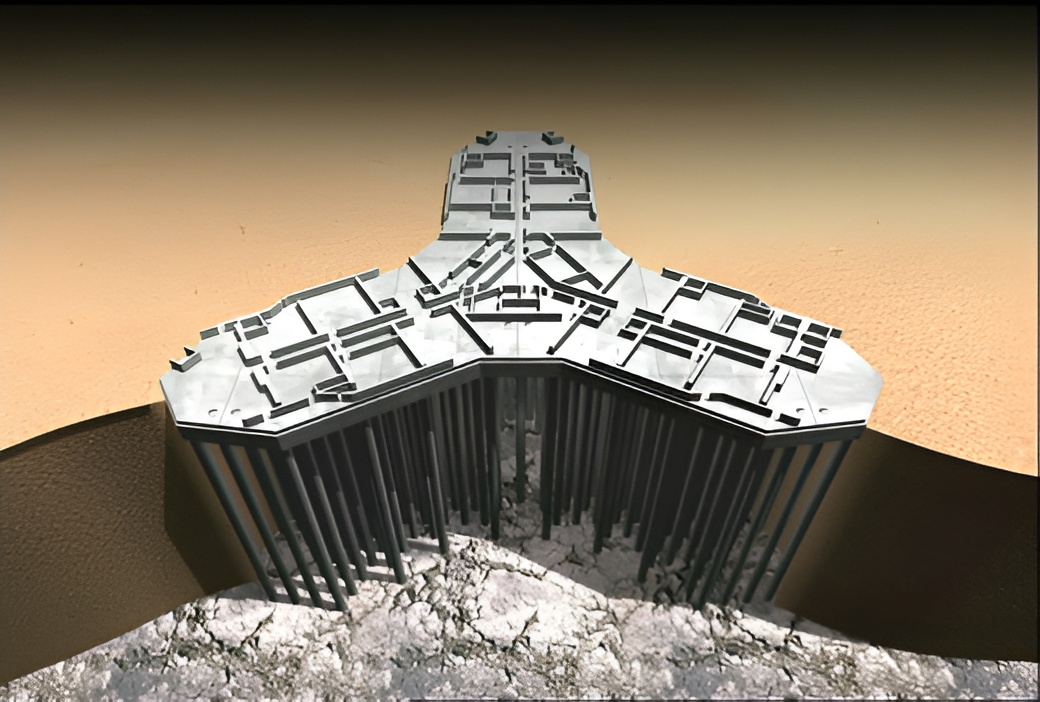
Piled rafts are often a cost-effective type of foundation in which the applied loads are carried partly by the piles and partly by the raft contact stresses, thereby allowing a significant reduction in required pile length as compared to a conventional pile foundation. The latest piled raft module of PGROUPN performs a non-linear boundary element analysis of the piled raft under general loading conditions. The negligible computational costs make the analysis suitable not only for the design of piled rafts supporting high rise buildings (generally based on complex and expensive 3D FEM or FDM analyses) but also for that of ordinary buildings and bridges. Further details on the piled raft module may be found in the paper by Basile (2015) on Computers and Geotechnics entitled “Non-linear analysis of vertically loaded piled rafts“.
Pile response to earthquakes
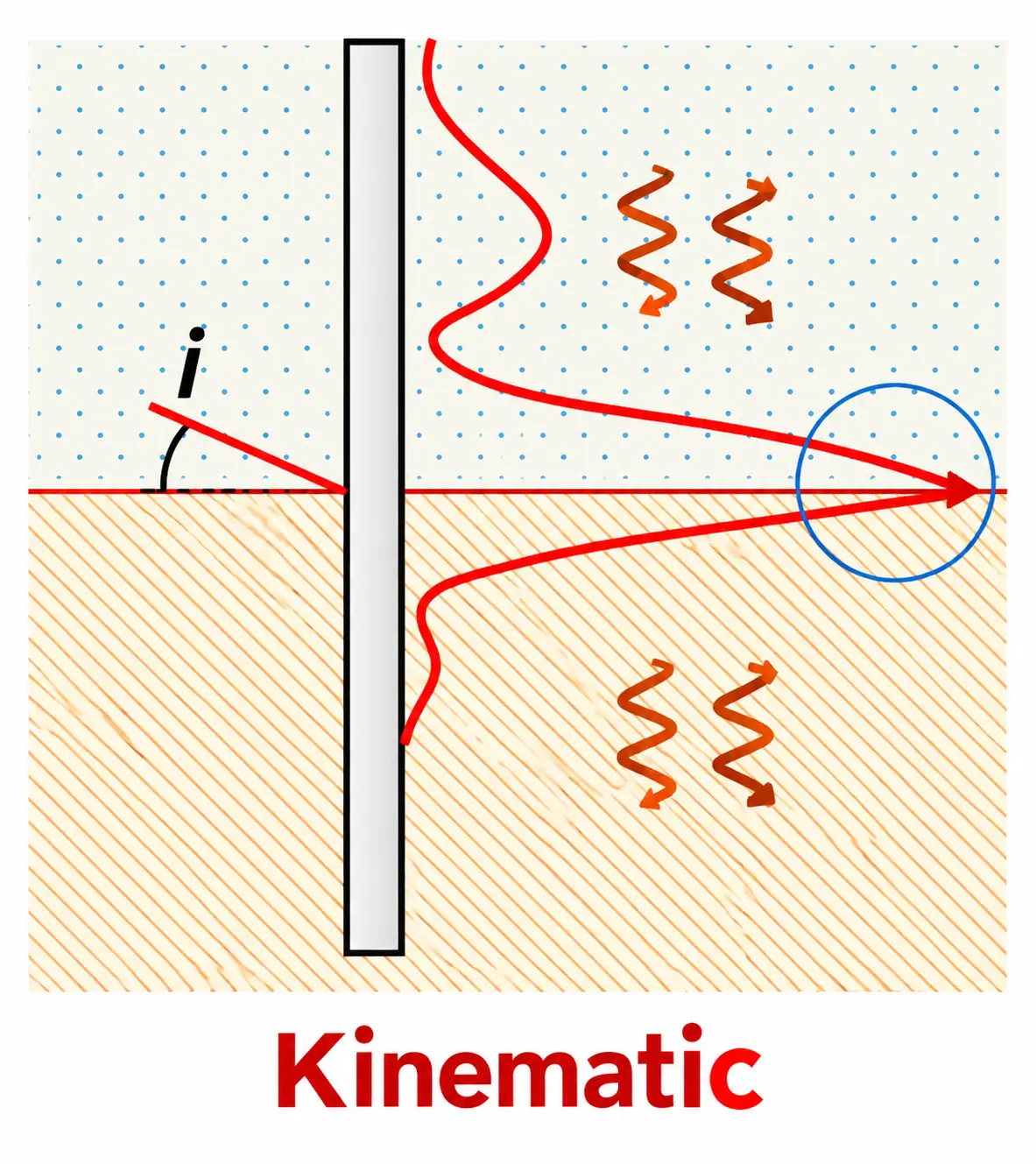
We can provide specialist advice regarding seismic analysis and design of pile foundations. Use is made of the latest seismic module of PGROUPN, based on a practical pseudostatic approach which overcomes the limitations of Winkler models and the cost and complexity of dynamic FEM analyses. The approach, which is capable of accounting for both inertial and kinematic effects (as required by Eurocode 8 Part 5, EN 1998-5), involves two main steps:
- Free-field site response analysis to obtain the maximum ground displacement profile along the pile and the maximum ground surface acceleration generated by the earthquake;
- Static non-linear boundary element analysis of the pile group to estimate the deformation behaviour and internal forces of the piles, subjected to the maximum free-field ground displacement profile (kinematic loading) and to the pile cap load given by the cap-mass multiplied by the maximum free-field ground surface acceleration (inertial loading).
Further details on the seismic module are available on the paper by Basile (2012) “Pile-group response under seismic loading“.
Pile response to tunnelling
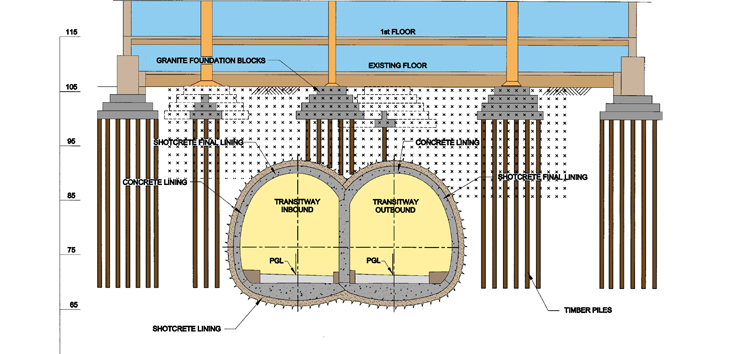
The latest tunnel module of PGROUPN provides a cost-effective method for estimating the deformation and load distribution of existing pile foundations during tunnelling excavation. Due to the negligible computational costs, a large number of cases can be analysed efficiently, enabling multiple tunnel configurations to be quickly examined and parametric studies to be readily performed. This represents a significant advantage over the cost and complexity of a complete 3D FEM/FDM analysis of tunnel-soil-pile interaction, particularly when non-linear soil behaviour is to be taken into account. The approach is based on two steps:
- Estimate of the free-field tunnelling-induced ground movements using alternative procedures, ranging from empirical methods and closed-form analytical solutions to 3D numerical analyses;
- Non-linear boundary element analysis of the pile group subjected to the computed free-field ground movements and to the superstructure loads.
Further details on the tunnel module are available on the paper by Basile (2014) “Effects of tunnelling on pile foundations“.

Commercial Properties
Sky Tail Tower
You can use these sections to highlight the features of heading. Use these paragraphs to focus on the topic you want. Make sure you keep it short and attractive.
- Blandit fugit dicta quibusdam, maxime tempor
- Blandit fugit dicta quibusdam, maxime tempor
- Blandit fugit dicta quibusdam, maxime tempor